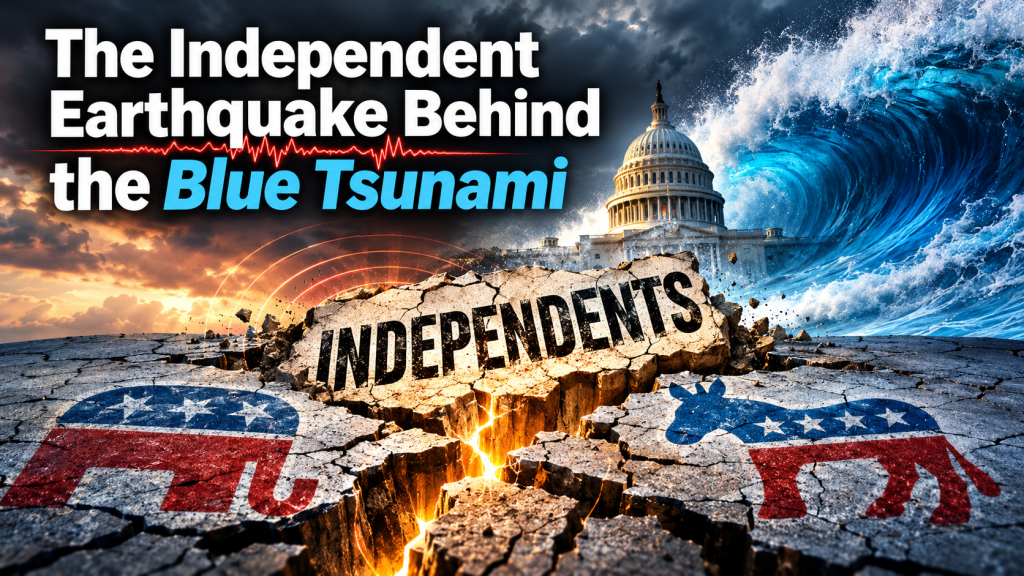
Democrats won Congress.
Republicans lost control.
And right on schedule, the political cheerleaders went to work.
Depending on which tent you occupy, you’re probably hearing about a glorious blue wave or a catastrophic rejection of Donald Trump.
The winners are celebrating.
The losers are pointing fingers.
Same circus.
Different election.
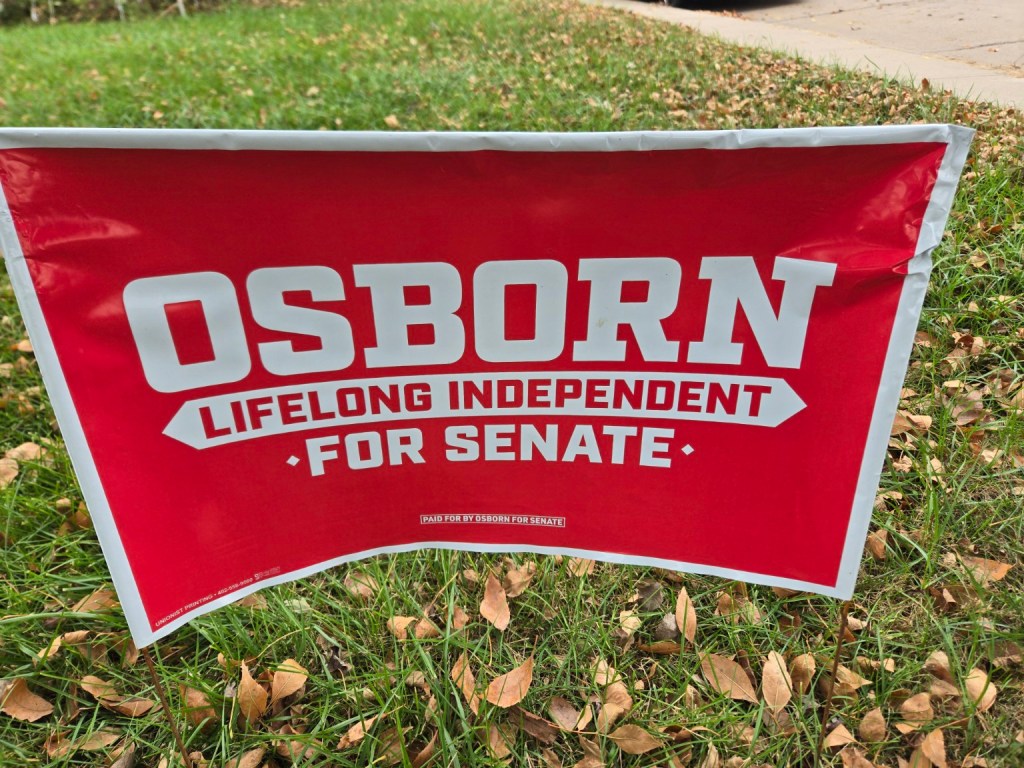
But I think there’s a bigger story here: independent voters.
Not because millions of Americans suddenly became politically enlightened overnight.
I wish.
Because the electorate might be changing in ways neither political party fully appreciates.
This time, I’ve got more than my usual opinions.
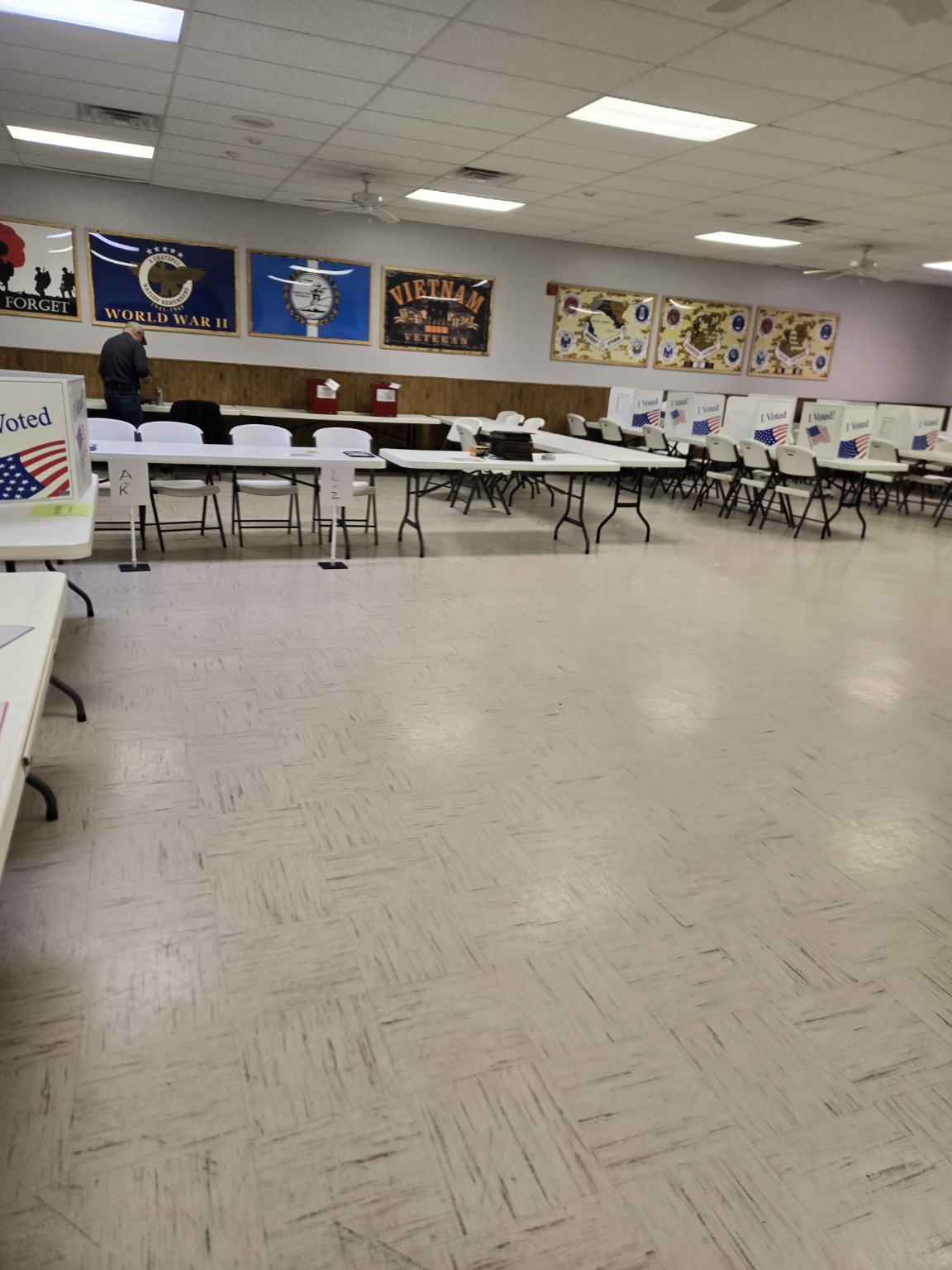
I spent thirteen hours working Election Day at the Veterans Club polling location in Grand Island, Nebraska. Before that, I researched my own ballot, candidates, judicial retention questions, and ballot initiatives.
Afterward, I went digging through turnout estimates, party identification, and voter surveys.
Winning an election and earning voters’ loyalty are two very different things.
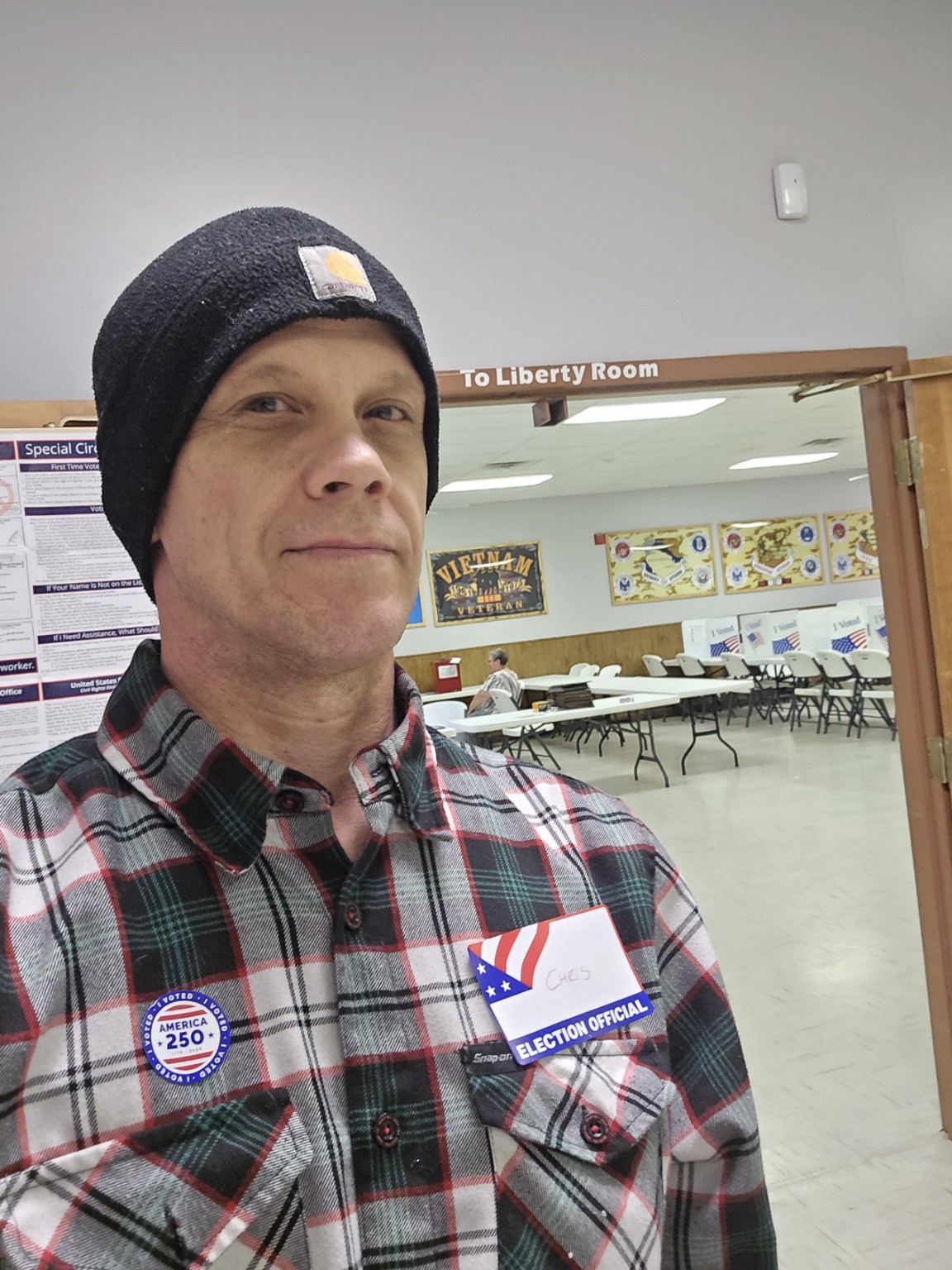
Thirteen hours on the other side of the ballot box
I’ve voted in plenty of elections.
I’ve even voted absentee from Baghdad while serving in the Marine Corps.
But this year I worked one.
I trained with the Hall County Election Commission, then spent Election Day helping administer an election in my own community.
One instruction stuck with me: don’t argue with a voter whose eligibility can’t immediately be established.
Follow the provisional-ballot process.
Those ballots are handled separately and reviewed by election officials before any determination about counting them.
There’s a process.
There’s documentation.
There’s accountability.
As a mechanic, I appreciate that.
You don’t diagnose a complicated electrical failure by pointing at the first component you don’t understand and declaring it defective.
Well, you can.
But you’ll probably waste money, accomplish nothing, and look like an idiot.
You follow the evidence.
Election integrity deserves that discipline.
So does election analysis.
First, who actually showed up?
Preliminary University of Florida Election Lab estimates put 2026 midterm turnout at about 124.3 million Americans, or 49.4% of the voting-eligible population.
That’s high by modern midterm standards, roughly comparable to 2018 and above 2022.
Encouraging?
Absolutely.
But it also means roughly half of eligible Americans still didn’t participate.
We spend billions campaigning, arguing, advertising, and insisting every election is the most important of our lives.
And roughly half the eligible population still sits out a midterm.
Apathy doesn’t disappear because your preferred candidates won.
When enough people stop paying attention, everyone else makes the decisions.
The largest political identity isn’t Republican or Democrat
Gallup’s 2025 annual averages, reported in January 2026, put political independents at 45% of American adults, versus 27% Democrats and 27% Republicans.
In 1988, independents were about 33%.
That’s a twelve-point increase across administrations of both parties.
Not exclusively a Trump phenomenon.
Not exclusively a Biden phenomenon.
Here’s the catch: many self-described independents still lean toward a party and vote consistently with it.
Independent identification isn’t necessarily independent thinking.
But why are so many people reluctant to identify directly with the parties they keep voting for?
Maybe they’re tired of being told that accepting one position means buying the whole ideological package.
I didn’t leave the Republican Party to become a Democrat
I was a registered Republican for years.
In 2022, I became an independent.
Not because I abandoned every belief I’d held.
And certainly not because I woke up convinced Democrats had all the answers.
I got tired of allowing a political organization to define my positions for me.
I believe in individual liberty, constitutional rights, personal responsibility, and accountable government. I support the Second Amendment, right to repair, voting rights after people complete their sentences, accessible primaries, and competitive elections.
Some of that makes Republicans happy.
Some makes Democrats happy.
Some pisses off both.
I’m fine with that.
A political party is not a personality. You don’t have to purchase the entire ideological package because you agree with one part.
That’s brand loyalty, not independent thinking.
And loyalty to a brand doesn’t make a defective product work.
What did independents actually do in 2026?
ABC’s national voter polling indicated that self-identified independents favored Democratic House candidates by approximately 58% to 38%.
A 20-point margin.
In 2024, national House exit polling put them around 49% Democratic to 48% Republican.
That’s a nineteen-point shift in the Democratic-versus-Republican margin.
Independents made up roughly a third of voters.
Multiplying that electorate share by the change in the surveyed margin yields about 6.3 points as a simple illustration of its potential contribution to the national two-party margin. That is not a causal estimate. It doesn’t prove the same people switched sides or that independents single-handedly flipped Congress.
It shows why this voting bloc matters.
Voting Democratic doesn’t mean liking Democrats
ABC’s 2026 voter poll also found that about 15% of voters disliked both major parties.
Among them, roughly 61% voted Democratic for the House and 33% Republican.
About 19% of Democratic House voters reportedly viewed the Democratic Party unfavorably.
That’s not a lifetime membership application.
That’s a choice among available candidates.
Sometimes you’re voting for someone you believe in.
Sometimes you’re voting against failure.
Sometimes you’re staring at two names and wondering how, in a country this big, those are the choices.
I’ve been there.
And yes, Trump mattered. A lot.
According to ABC’s voter poll, about 44% said opposition to Trump was a factor in their House vote, while 16% said support for him was a factor.
Ignoring that would be intellectually dishonest.
But voting against Trump is not necessarily voting for the Democratic Party.
Congress isn’t supposed to be a presidential fan club.
It’s a separate, coequal branch.
Members should legislate, conduct legitimate oversight, represent constituents, and exercise independent judgment.
Not blindly defend their party’s president.
Not blindly obstruct the other party’s president.
Republicans investigate Democrats.
Democrats investigate Republicans.
One party spends its turn undoing the other party’s work.
Then the pendulum swings back.
And back.
Harder every time.
Meanwhile, ordinary Americans stand underneath the damn thing getting wrecked.
I don’t want Democrats to waste two years punishing Republicans for being Republicans.
I want Congress to do its job.
Investigate actual wrongdoing.
Pass legislation.
Negotiate.
Remember the millions of people who didn’t vote for them.
That’s not weakness.
That’s representative government.
Did voters switch, or did different voters show up?
This is where my inner mechanic takes over.
Imagine one person voted Republican in 2024 and Democratic in 2026.
Another voted Republican in 2024 and stayed home in 2026.
A third didn’t vote in 2024 and turned out Democratic in 2026.
All three change the electoral equation.
Only one actually switched from a Republican candidate to a Democrat.
Pew’s validated-voter research found that among citizens eligible in 2020, 2022, and 2024, about 41% participated in all three elections, while 26% participated in none.
Three elections.
Zero participation.
That’s a hell of a lot of Americans leaving decisions to everybody else.
The available 2026 evidence suggests independent preferences shifted, Democrats were motivated, some Republican-aligned voters disengaged or broke ranks, and Trump was a major factor. We don’t yet have the validated individual voter transitions to calculate precisely how much each contributed.
I’m not inventing an answer for a better headline.
My ballot didn’t come with a team jersey
I requested an early ballot because I was assigned to work outside my own precinct.
I sat at home with it, researched candidates and records, examined ballot initiatives, and worked through judicial retention questions.
Some choices were easy.
Others took homework.
I don’t expect everyone to agree with my choices.
Hell, I don’t expect everyone to agree with half of them.
But we owe ourselves more than checking a box because somebody put an R or a D next to a name.
As a mechanic, I can’t tell a customer a truck is fixed because I like the manufacturer.
I identify the problem, explain the diagnosis, make the repair, and verify it worked.
Why should government get a lower standard?
If a politician says something’s broken, show me what.
If there’s a proposed fix, explain how it works.
If elected, show me the results.
That’s accountability, and it doesn’t have a party affiliation.
What about younger Americans?
Gallup reported that 56% of Gen Z adults identified as independent in 2025, along with a majority of millennials. But CIRCLE estimated that only about 27% of eligible 18-to-29-year-olds voted in the 2026 midterms, roughly unchanged from 2022.
Political independence without participation doesn’t accomplish much.
I tell my kids you can only lose if you quit or your time runs out.
Setbacks aren’t losses; they’re part of the game.
Your candidate might lose.
A policy might fail.
Someone you supported might disappoint you.
The answer isn’t necessarily to quit.
It’s to pay attention, ask questions, and hold people accountable.
So was 2026 a blue wave?
Democrats made substantial congressional gains.
That’s the result.
But it doesn’t mean America suddenly fell in love with the Democratic Party.
Independents shifted, Democrats mobilized, some Republicans disengaged, and opposition to Trump mattered.
Those aren’t competing explanations.
They’re pieces of the same puzzle.
Americans regularly express disapproval of Congress and then return incumbents to office.
At some point we have to acknowledge that representative government reflects the choices we make, including the choice not to participate.
We can’t blame Washington for everything while refusing to examine ourselves.
What does it mean for 2028?
I’m cautiously optimistic.
Not because Democrats won.
Not because Republicans lost.
And certainly not because one election cured tribalism.
I’m optimistic because participation is relatively high, independent identification has reached record levels, and voting preferences can change dramatically.
But independent identity and independent judgment aren’t the same thing.
We still need to learn whether Americans are becoming less partisan or simply more dissatisfied with whichever party holds power.
I suspect it’s some of both.
I don’t want a country where everybody agrees with me.
That would be boring as hell.
I want a country where a Republican can criticize a Republican, a Democrat can criticize a Democrat, and an independent can criticize both without being accused of secretly belonging to whichever party somebody hates more.
I spent thirteen hours watching the machinery of democracy operate from the other side of the ballot box. Then I went back to what I always do: looking at the numbers, asking questions, and refusing to confuse an assumption with a diagnosis.
I don’t know exactly what 2028 brings.
I’ll be watching participation, independent identification, voting behavior, and incumbent accountability.
Because something important might be happening beneath all the partisan noise.
Americans may not be falling in love with either political party.
They may be becoming more willing to withdraw their support.
Sources and methodology
Read the underlying research: University of Florida Election Lab (2026 turnout); Gallup (political identification); ABC News (2026 House voter poll); ABC News (2024 House exit poll); Pew Research Center (validated turnout); and Tufts CIRCLE (youth turnout).
Research note: The 2026 turnout and youth estimates are preliminary.
National voter surveys are not individual voter records.
Comparisons between different elections can reflect changes in who voted, survey methods, and candidate choice; they do not establish that particular individuals switched votes.
Charts are original editorial visualizations of the cited figures.




Leave a Reply