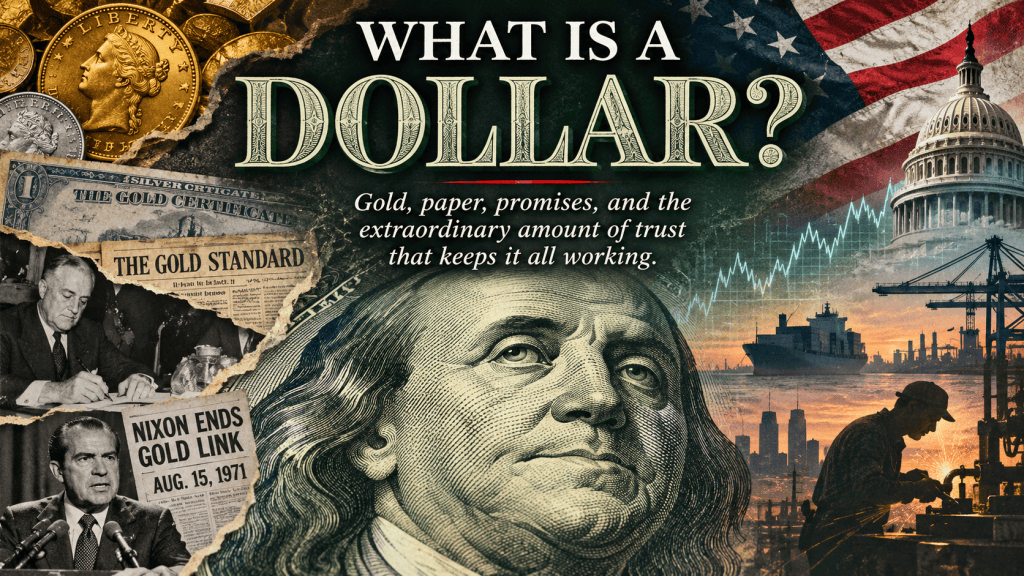
I’ve got a question.
What is a dollar?
No, seriously.
What the fuck is a dollar?
Not what can you buy with one. We all know that answer gets a little more depressing every year.
I’m asking what gives that little green piece of paper its value.
It’s cotton and linen. The materials aren’t worth a dollar. Yet people work their entire lives to accumulate enough dollars to retire.
So let’s talk about money.
Once upon a time, money was actually something
People have used livestock, grain, shells, and precious metals to exchange value. Gold and silver were especially useful: scarce, durable, recognizable, and difficult to produce.
The Coinage Act of 1792 established an American monetary system defined in terms of gold and silver. That’s bimetallism.
Money had a legally specified metallic definition. But even that system depended on laws, institutions, and confidence. The market relationship between gold and silver could change.
Even metal-backed money was never quite as simple as the nostalgia suggests.
The gold standard
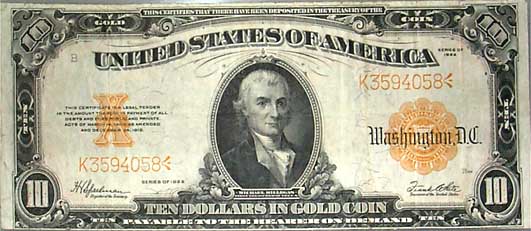
In 1900, the United States formally adopted the gold standard. A dollar had a defined relationship to gold, constraining monetary policy.
That didn’t eliminate financial panics, deflation, or economic crises.
During the Great Depression, Roosevelt suspended domestic gold convertibility in 1933. In 1934, the official gold price changed from $20.67 to $35 an ounce.
The gold hadn’t changed.
The rules had.
Remember silver certificates?
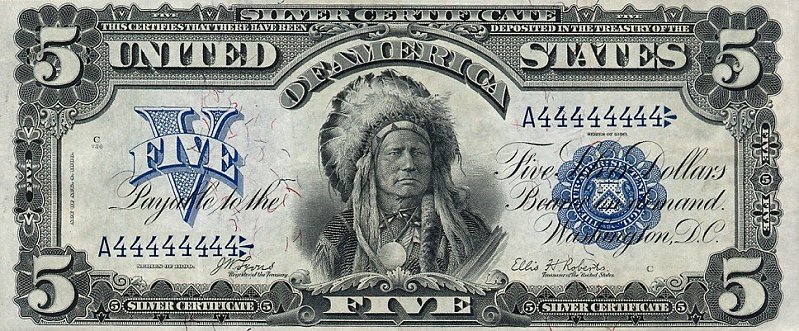
Old bills labeled SILVER CERTIFICATE weren’t just decorative. They represented a claim redeemable for silver under the rules then in force.
Silver certificates began in 1878. Printing ended in the 1960s, and redemption for silver bullion ended on June 24, 1968.
The certificates remained legal tender.
The promise behind them changed, but the paper remained money.
Interesting, isn’t it?
Then came 1971
After World War II, the Bretton Woods system put the dollar at the center of international finance. Foreign monetary authorities could convert dollars into U.S. gold at the official $35-an-ounce rate.
But the supply of dollar claims abroad grew relative to American gold reserves.
In August 1971, Nixon suspended that convertibility. The last major international dollar-gold redemption link was broken, and the world eventually moved toward floating exchange rates.
The dollar became a fiat currency, without a fixed promise to exchange it for gold or silver.
So what backs it now?
In God We Trust?
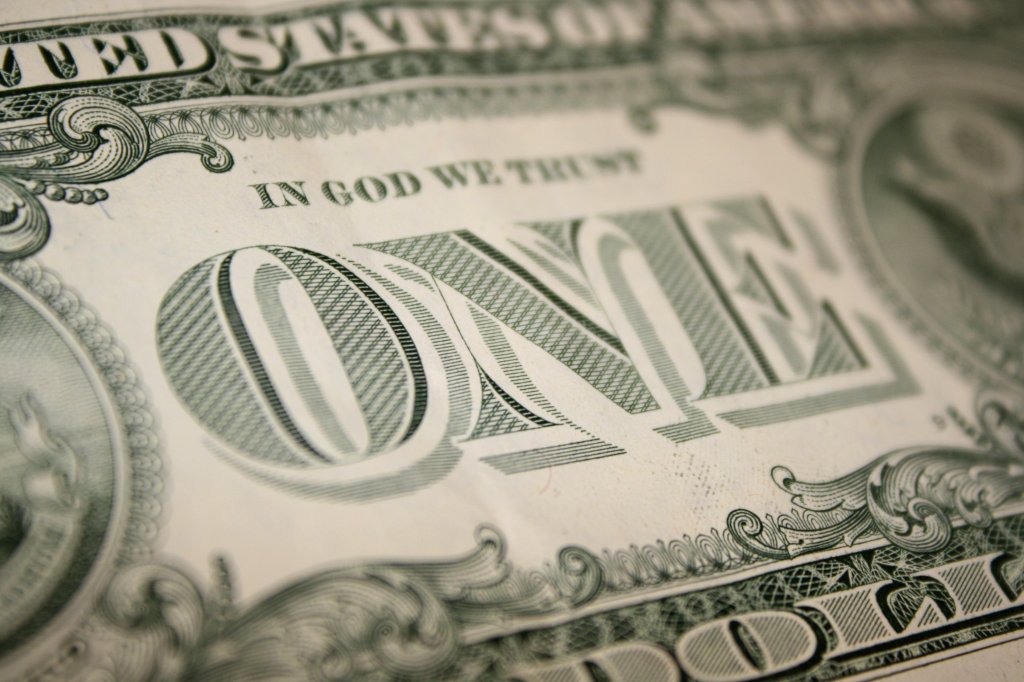
Take a dollar out of your wallet. Look at the back.
IN GOD WE TRUST.
As an atheist, I find that particularly entertaining.
Because modern money really does depend on trust. Not necessarily in God. In the economy, the institutions, the people, and the expectation that someone else will accept it tomorrow.
But it’s not just hopes and dreams. The government collects taxes in dollars. Debts and contracts are denominated in dollars. American businesses produce goods and services. U.S. financial markets are deep and liquid. The Federal Reserve manages monetary conditions.
Faith, backed by an economy.
So what happens when we create more dollars?
This is where the conversation goes off the fucking rails.
Somebody screams about printing money out of thin air. Somebody else insists it’s complicated.
Irritatingly, both have a point.
Commercial bank lending creates deposits. Federal Reserve operations affect reserves and financial conditions. Federal deficits are financed through borrowing. These mechanisms interact, but they’re not interchangeable.
Money and credit expanding faster than productive capacity can contribute to inflation. So can supply shocks and other pressures. It’s not a one-variable equation.
But we know the feeling when prices rise faster than wages.
Your bank account can show more dollars while your standard of living gets worse.
Are you wealthier, or did we just change the numbers?
The dollar isn’t the same thing as wealth

Imagine two towns. Each has a thousand dollars circulating through it.
One has farms, power, skilled workers, functioning roads, and businesses making things people need.
The other has a thousand dollars and not much else.
Same amount of money.
Not remotely the same amount of wealth.
Now imagine giving everyone in the second town another thousand dollars. That might change who can afford what, and it might help finance real production if resources are available. But it doesn’t magically build a grocery store, train a surgeon, or put food on a shelf.
Money can help organize production. It cannot substitute for production.
And that’s why inflation isn’t just an argument about how many dollars exist. It’s also about how much real stuff those dollars are chasing, and whether the economy can make more of it.
The part that really bothers me
Republicans want to cut this. Democrats want to fund that. Somebody wants another tax break. Somebody else wants another spending program.
But money and wealth aren’t the same thing.
Actual wealth is the food we grow, housing we build, energy we produce, infrastructure we maintain, and skills people bring to the job.
You can create more dollars. You can’t create another thousand electricians, doctors, or mechanics just by adding zeros to a bank account.
I work on trucks. I can write a transmission repair estimate for $10,000. Or $20,000. Hell, a million dollars.
None of those numbers fixes the truck.
Somebody still has to make the parts, diagnose the failure, and turn the fucking wrenches.
The number on the invoice isn’t the work.
Who creates the wealth, and who gets to keep it?
Here’s where the conversation gets uncomfortable.
When the American economy becomes more productive, we can produce more with the labor and resources we have. That’s real progress.
But it doesn’t automatically mean every American gets a bigger piece.
Productivity gains can become higher wages, lower prices, better products, higher profits, or bigger returns to investors. How those gains are divided depends on competition, bargaining power, ownership, and policy.
Imagine a shop figures out how to repair twice as many trucks with the same crew and the same hours.
Maybe the technicians get raises. Maybe customers get lower bills. Maybe the owner buys better equipment. Maybe the business keeps most of the benefit as profit.
Or some combination of all four.
But don’t tell me that because the shop’s revenue went up, every mechanic must be doing better.
Growth tells us the pie got bigger. It doesn’t tell us who got another slice.
And there’s another wrinkle. Paychecks are measured in dollars. Standards of living depend on what those dollars buy.
If wages rise five percent and a family’s expenses rise eight percent, that family can be worse off despite earning more. If productivity makes useful goods cheaper, families can benefit even without dramatic raises.
So I don’t think the only question is whether GDP grew or the stock market went up.
Can ordinary Americans afford more of the things that make life worth living?
A home. Food. Healthcare. Transportation. Time with their kids. A realistic chance of retiring before their bodies give out.
Those aren’t all captured by one statistic. Averages hide differences between households.
None of this means profits are evil. Investment and risk matter. So do skill and labor.
But an economy can grow while many of the people keeping it running don’t feel richer.
And when that happens, maybe we should stop telling them the numbers prove they’re doing great.
Maybe we should ask what the numbers are missing.
What exactly are we trusting?
Not just that the government won’t print too much money.
We’re trusting that contracts will be enforced. That courts will function. That taxes will be collected. That banks will settle payments. That the Federal Reserve can act credibly. That businesses will keep investing and workers will keep producing.
We’re also trusting that the government can service its debts without resorting to policies that destroy confidence in the currency.
And there’s an uncomfortable feedback loop here.
America’s economic strength helps make the dollar desirable around the world. That demand helps America borrow and transact on favorable terms. Those advantages can strengthen the economy further.
But none of that is a blank check.
When politicians treat public trust as something they can spend without replenishing, they’re gambling with an asset that never appears neatly on a balance sheet.
Credibility is economic infrastructure.
The most expensive trust exercise in human history
For more than half a century, the dollar has operated without fixed gold convertibility.
Despite inflation, recessions, banking crises, debt, and political dysfunction, it remains central to global finance.
That’s a testament to American productive capacity, financial markets, and institutions.
But dominance isn’t invincibility.
Confidence can be damaged. Institutions can be weakened. Alternatives can become more attractive.
And history doesn’t guarantee that any currency will dominate forever.
And what about the national debt?
Debt isn’t automatically proof of national failure. Governments borrow for different reasons, and borrowing can finance things that make a country more productive.
But interest costs are real. So are the choices required to service them.
There’s a difference between borrowing to build something that expands future capacity and borrowing without a credible plan to manage the obligations.
I’m not interested in pretending there’s a magic debt number at which America suddenly collapses. There isn’t.
I’m interested in whether our leaders understand that the country’s ability to borrow on favorable terms is partly a privilege earned through generations of credibility.
And whether they’re treating that privilege like an unlimited credit card.
What happens when we stop trusting each other?
There’s another ingredient that’s harder to measure.
Each other.
Every paycheck assumes an employer will honor an agreement. Every bank deposit assumes the financial system will function. Every business transaction assumes strangers will generally deliver what they promised.
We don’t have to agree on politics, religion, or much of anything else to make an economy work.
We do have to believe that the rules mean something, that obligations will be honored, and that the person on the other side of a transaction isn’t automatically our enemy.
That’s not some sentimental argument that Americans used to get along perfectly. We didn’t. And distrust can be perfectly rational when people or institutions have earned it.
But a country that cannot distinguish healthy skepticism from reflexive suspicion has a problem bigger than its currency.
Trust makes cooperation less costly. When it erodes, lending, hiring, investing, and planning can all become harder.
So maybe the question isn’t simply whether we have enough dollars.
Maybe it’s whether we still have enough confidence in the people and institutions that make those dollars useful.
So, what is a dollar?
A dollar is a promise.
Not a promise that the government owes you a piece of gold. Not a guarantee that prices will stay where they are.
More accurately, an expectation: that the economy will keep producing things worth buying, that the institutions keeping score will function, and that somebody else will accept those dollars tomorrow.
Think about what that means.
Every morning, millions of Americans trade hours of their lives for numbers in bank accounts.
We trust that those numbers will eventually become groceries, a mortgage payment, a repaired car, an education, or maybe a few years of retirement before we die.
And every transaction requires another human being to participate.
The farmer. The truck driver. The cashier. The nurse. The mechanic. The person you’ve never met and probably never will.
We don’t need to like each other. We don’t need to vote the same way. We don’t even need to agree about what this country ought to be.
But we do need enough shared trust to work together, honor our obligations, and believe the system is worth participating in.
Healthy skepticism is necessary. Blind faith isn’t the answer. Trust has to be earned, and institutions that break it deserve scrutiny.
But there’s a difference between holding each other accountable and deciding that everybody on the other side of an argument is an enemy.
Gold can’t fix that.
Neither can the Federal Reserve.
And printing another trillion dollars sure as hell won’t.
Which brings me back to the question I started with.
What is a dollar?
Maybe it’s one of the most remarkable agreements human beings have ever made.
And maybe its greatest vulnerability isn’t the paper, the ink, or the fact that there’s no gold sitting behind it.
Maybe it’s us.
If the dollar is ultimately backed by confidence in the American economy, what happens when Americans themselves begin losing confidence in that economy?
And in each other?
Sources and further reading
Historical references: Congressional Research Service, Brief History of the Gold Standard in the United States; Federal Reserve History, Gold Reserve Act of 1934; U.S. Mint, Treasury announcement on the end of silver-certificate redemption; Federal Reserve Bank of New York, Demise of Silver Certificates; and Bureau of Engraving and Printing, Gold and Silver Certificates.
Economic context: Bureau of Labor Statistics, Labor Productivity and Costs; FRED, Real Median Weekly Earnings; and Bureau of Economic Analysis, Gross Domestic Product.
Editorial note: The relationship between economic performance, confidence, and interpersonal trust is an argument explored in this essay, not a claim that the dollar has a measurable one-to-one dependence on any single public-opinion measure.




Leave a Reply